The biggest mistake first-time authors make when hiring a ghostwriter has nothing to do with choosing the wrong person. It happens before the collaboration even begins. They show up to the first meeting with a rough idea in their head, a folder of disorganised notes, and the vague hope that a skilled writer will somehow extract their entire book from a thirty-minute conversation.
A ghostwriter can only work with what you give them. And what you give them at the start — the brief — determines the quality of everything that follows. A weak brief produces drafts that miss the mark, require endless revisions, and frustrate everyone involved. A strong brief does the opposite: it compresses the discovery phase, aligns the ghostwriter with your vision from day one, and produces first drafts that already sound like you.
Here is the insight that most authors in 2026 are not yet using: AI tools like ChatGPT and Claude are extraordinarily effective brief-preparation tools when used correctly. Not as ghostwriters themselves — that is a different conversation entirely — but as thinking partners that help you clarify your voice, your goals, your audience, and your structure before you ever speak to a human ghostwriter. This guide walks you through exactly how to do it.
Why the Brief Is the Most Important Thing You Will Prepare
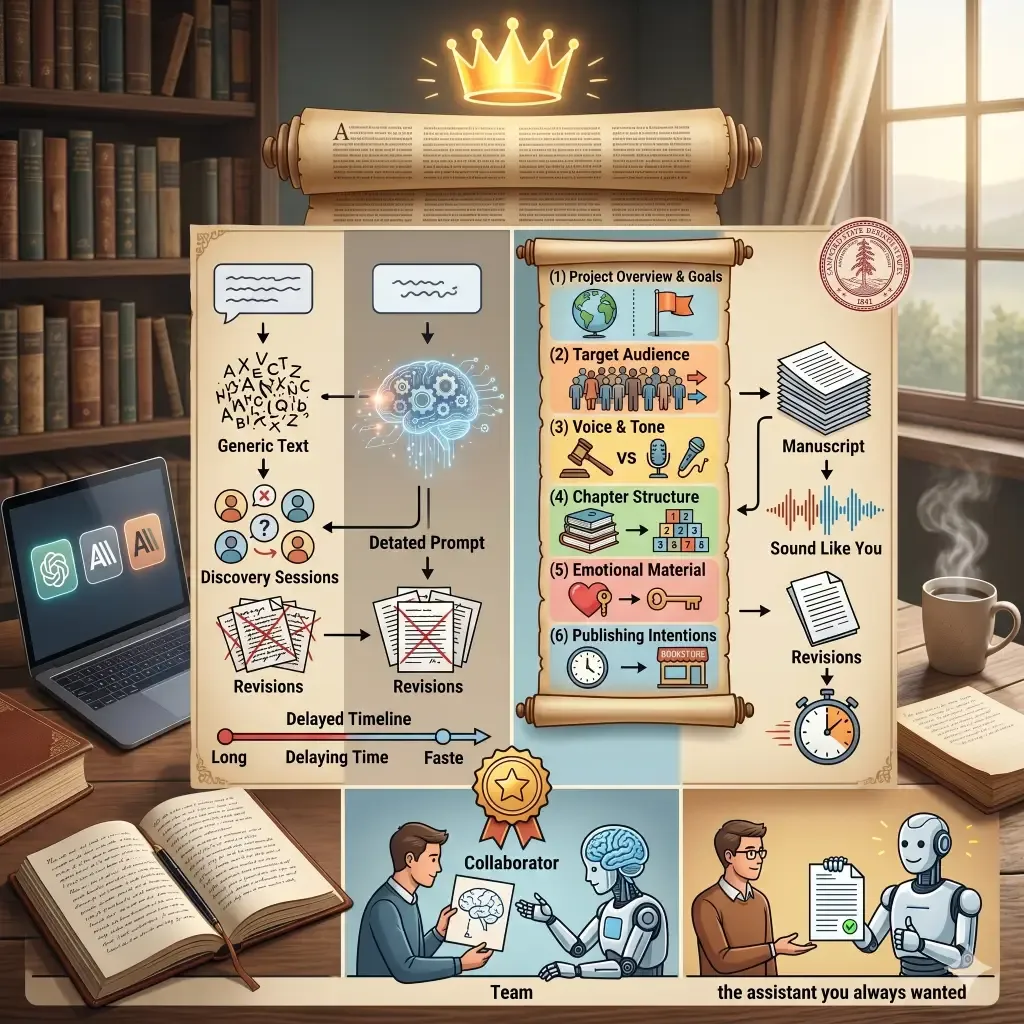
Before getting into the AI mechanics, it is worth understanding why the brief matters so much. A ghostwriter brief is not just an instruction document. It is the first real test of whether you actually know what you want your book to be.
A Stanford research paper on AI in writing found that the quality of AI output correlates directly with the specificity of human input. Vague prompts produce generic text. Detailed briefs produce manuscripts that sound like you. The same principle applies directly to human ghostwriters. The more specific, accurate, and structured your brief, the fewer discovery sessions your ghostwriter needs, the fewer revisions occur in early drafts, and the faster your manuscript reaches the quality level you are paying for.
A strong ghostwriter brief covers six core areas: your project overview and goals, your target audience, your voice and tone, your chapter structure or outline, the emotional or experiential material the ghostwriter needs to access, and your publishing intentions and timeline. Most first-time clients arrive with one or two of these prepared. AI tools can help you develop all six before your first meeting, making you a significantly better collaborator from the start.
According to the American Society of Journalists and Authors, successful ghostwriters describe AI not as a writer but as “the assistant you always wanted.” As Georgetown writing lecturer Michael Long put it: “It’s a brilliant literalist. The key to success is telling it exactly what you want.” That description applies equally to using AI to prepare what you want to tell your ghostwriter.
Step 1: Use Claude or ChatGPT to Extract and Document Your Writing Voice
The most critical element of any ghostwriter brief is a voice profile. Your ghostwriter must write content that sounds unmistakably like you — not like a generic author, not like the AI, and not like the ghostwriter’s own style. Getting voice right requires either hours of interviews or a well-prepared voice document. AI can help you build the second one in under an hour.
Here is how to do it with Claude, which is particularly well-suited for nuanced voice analysis. Open a Claude conversation — Claude Pro at claude.ai is recommended because its large context window lets you upload substantial samples of your existing writing at once. Paste in writing samples from different contexts: an email you wrote to a colleague, a speech you gave, a LinkedIn post, a journal entry, anything in your own natural voice. Then ask Claude directly: “Analyse the writing style in these samples and describe my voice in specific, usable terms — my sentence length preferences, whether I use passive or active constructions, the vocabulary level, my tendency toward humour or seriousness, how I handle technical information, and what tonal patterns repeat across all of these samples.”
The output Claude produces should not go directly into your brief. Review it, correct anything inaccurate, and add what the AI cannot infer from text alone: the things you feel strongly about in terms of how you want to come across, the authors whose writing you admire and why, the words or phrases you specifically want avoided. This annotated voice profile becomes the most valuable document you hand your ghostwriter — and it would have taken you days to produce through reflection alone. A 2026 analysis on using Claude for voice matching found that reproduction accuracy of style visibly improves once a model has access to substantial past writing. The writer’s personal quirks, comedic instincts, and in-jokes are harder to capture and require the human editing layer to complete.
ChatGPT performs a slightly different function here. It is particularly strong at restructuring scattered notes into organised summaries, which is useful for authors who have been accumulating ideas in disorganised documents for months. If your “brief material” currently lives across twelve voice memos, three Word files, and a set of old emails, paste everything into ChatGPT and ask it to identify recurring themes, key arguments, and the emotional through-line. This synthesised material becomes the project overview and chapter framework sections of your brief.
Step 2: Build Your Audience Profile Using AI as an Interviewer
Most authors have an intuitive sense of who they are writing for, but they struggle to articulate it in the specific terms a ghostwriter needs. The ghostwriter is not just writing for you — they are writing for your readers. Understanding the reader’s knowledge level, emotional motivations, likely scepticisms, and vocabulary determines every editorial choice the ghostwriter makes.
Use Claude or ChatGPT in dialogue mode for this step. Start by describing your intended reader in general terms — “I’m writing for mid-career professionals in the finance sector who feel stuck at the director level and want to move into executive roles.” Then ask the AI to interview you. A useful prompt is: “Ask me ten questions about my target reader that a professional ghostwriter would need answered before starting a book project. Ask them one at a time and probe my answers.”
This conversational approach surfaces specificity you would not have produced from a blank document. What does your reader already know about this topic? What are they afraid of? What has already failed for them? What would make them stop reading? What language do they use when they talk about their own situation? Your answers to these AI-generated questions, compiled into a paragraph, become the audience section of your brief — and it is richer and more specific than anything most clients deliver unprompted.
For nonfiction books, business titles, and ebook projects, this audience profile is particularly critical because the ghostwriter must write with your specific reader’s knowledge level and vocabulary in mind from the first sentence. A brief that says “my audience is business people” is not useful. A brief that says “my audience is first-generation entrepreneurs running services businesses between $2M and $10M in revenue, who have read every business book but still feel like outsiders in high-level business conversations” gives a ghostwriter something real to work with.
Step 3: Use AI to Stress-Test and Organise Your Book Structure
Most authors arrive at their first ghostwriting meeting with a rough chapter list that seems logical to them but has structural problems a reader would feel immediately. The chapters repeat themes. The strongest material is buried in chapter six. The hook is missing from the beginning. An experienced ghostwriter will eventually catch and fix these problems, but catching them before the brief is submitted saves weeks of redrafting.
Claude is especially effective at structural analysis of long-form content. Paste your rough chapter outline — even if it is just a list of topics — and ask: “Analyse this book structure as an experienced developmental editor would. Identify: where the reader’s momentum is most at risk of dropping, which themes appear to overlap or repeat, whether the opening creates sufficient reason for the reader to continue, and where the central argument is strongest and weakest.” The critique Claude produces is not always accurate, but it raises questions you need to have answers to before your ghostwriter starts writing.
You can also use this step to test whether your book’s central argument is clear and compelling. Summarise your book’s premise in three sentences and ask Claude: “Is this premise specific enough to differentiate a book on this topic? What are the three most likely objections a reader or publisher would raise against this argument?” If you cannot answer Claude’s pushback clearly, your premise needs more development before your ghostwriter can build a coherent manuscript around it.
For manuscript writing services, this structural clarity is particularly valuable. Ghostwriters working on full manuscripts charge by scope and deliver against an approved outline. A structurally sound outline approved at the brief stage means fewer paid revision cycles later.
Step 4: Use AI to Draft the Brief Document Itself
Once you have your voice profile, audience analysis, and structural framework, use AI to compile them into a formatted brief document. This is a legitimate and highly effective use of ChatGPT or Claude in the process. Paste in your raw notes from the previous three steps and ask: “Organise this material into a professional ghostwriter brief with the following sections: Project Overview, Author Goals, Target Audience, Voice and Tone Profile, Chapter Structure, Key Stories and Experiences to Include, Research and Reference Materials, Publishing Intentions, Timeline, and any specific requests or constraints.”
The draft document Claude or ChatGPT produces will be approximately eighty to ninety percent ready to send. Review it carefully for accuracy, add the personal details and emotional content that only you can supply, and verify that every section reflects your actual intentions rather than the AI’s best guess at what you meant. A ghostwriter brief that went through an AI compilation step is not a problem — it is efficient. What matters is that you review and own every statement in it before it reaches your ghostwriter.
The Gotham Ghostwriters AI guidelines, released on April 22, 2026, address exactly this kind of use clearly. If a client provides AI-generated source material to their ghostwriter, they need to say so. That material carries the same factual, copyright, and plagiarism risks as anything else AI generates. A client who hands over an AI-written brain dump without disclosing it is potentially setting their ghostwriter up for a problem they didn’t agree to take on. Be transparent about which parts of your brief were AI-assisted, and make sure your ghostwriter knows which sections represent your verified thinking versus AI-generated placeholder language you want them to treat as a starting point for discussion.
Step 5: Use Claude Projects to Create a Persistent Voice Reference
Claude’s Projects feature — available on Claude Pro at claude.ai — allows you to create a persistent knowledge base that Claude references across all conversations within that project. For authors working on a book with a ghostwriter, this is a powerful tool for creating a living voice reference document.
Create a Claude Project specifically for your book. Upload your voice profile, your brief document, samples of your best personal writing, any relevant speeches or presentations, and a short “author background” note that explains who you are and what you have lived through. Then, whenever you are preparing materials for your ghostwriter — additional chapter notes, new stories you want to include, responses to your ghostwriter’s questions — do so within this Project. Claude will consistently reference the established voice parameters as it helps you articulate and organise ideas.
The result is a set of project materials that are internally consistent in voice and tone from the start. When your ghostwriter receives them, everything you have provided will use the same terminology, the same framing of your ideas, and the same voice patterns — which dramatically simplifies their voice-matching process and reduces the number of discovery conversations needed.
This approach is particularly effective for memoir writing and article writing projects where consistent personal voice is the defining quality of the work.
What to Keep in Mind: AI-Assisted Briefs vs Traditional Briefs
There are important limitations to acknowledge when using AI tools to prepare your brief.
AI cannot replicate what comes out of a genuine interview. Gotham Ghostwriters CEO Dan Gerstein has noted that “a technology that relies on human prompts can’t come up with concepts and book hooks that are original to the author’s unique ideas and life experience. It can’t extract insights and stories that can’t be found in any LLM because they exist only in the author’s head.” An AI-prepared brief is not a substitute for your ghostwriter’s discovery process — it is preparation that makes that process more efficient and more productive.
There is also a privacy consideration. By default, material uploaded to public AI models can be used to train those models, which could compromise a client’s confidential information or intellectual property. Writers using AI tools on client projects need to know which settings to use to limit this, and clients need to know their writer is paying attention to it. Before uploading personal stories, confidential business information, or unpublished ideas to any AI platform, enable private or non-training settings in your account. On Claude, this is managed through the Privacy settings in your account dashboard. On ChatGPT, disable “Improve the model for everyone” in the data controls settings.
Finally, AI tools will fill in gaps with plausible-sounding content when your instructions are vague. Review every AI-generated section of your brief with the specific question: “Did I actually say this, or did the AI infer it?” Any section where you are not sure deserves to be rewritten in your own words before it is shared with your ghostwriter.
The Complete Ghostwriter Brief Checklist (AI-Assisted)
Use the following as your quality checklist before sending any ghostwriter brief, regardless of how it was prepared.
Every strong brief includes a clear project overview of no more than three sentences that explains what the book is, why it exists, and who it serves. It includes a specific audience profile that goes beyond demographics to describe the reader’s mindset, knowledge level, and emotional state. It contains a voice and tone document with real writing samples, specific voice characteristics, comparable authors, and an explicit list of phrases or styles to avoid. It has an approved chapter structure with a rationale for the sequence, not just a list of topics. It identifies the specific personal stories, professional experiences, or emotional moments you want included. It states your publishing intentions — self-publishing, traditional publishing, ebook, print, hybrid — because these affect how a ghostwriter structures and positions the work. And it includes your realistic timeline with milestone expectations and a stated preference for how you want revisions communicated.
A brief that covers all of these areas can be prepared in two to three hours with AI assistance. Without AI, most authors find it takes days of drafting and revision. The investment of two to three hours upfront saves both parties weeks of misaligned effort later, and it signals to your ghostwriter that you are a serious, prepared collaborator — which consistently produces better work.
If you are ready to work with a professional ghostwriter and want to understand how to prepare for that process, Ghostwriting India offers initial consultation calls to help you develop your brief before committing to a full project. We work across books, ebooks, manuscripts, articles, children’s books, and web content. Reach out here to start the conversation.
The ghostwriter brief is not a bureaucratic formality. It is the document that determines whether your collaboration produces a book worth your investment. And in 2026, you have better tools than ever to prepare it well.
Using Claude to extract and document your writing voice, ChatGPT to synthesise your disorganised ideas into a structured overview, and AI-guided questioning to build a specific audience profile is not a shortcut — it is preparation. It respects your ghostwriter’s time, speeds the entire project, and produces better first drafts than most clients receive when they arrive unprepared.
The human collaboration that makes ghostwriting valuable remains irreplaceable. A ghostwriter acts as a structural engineer, taking raw material and building a logical framework. They understand the psychology of the reader — where to build tension, where to provide data-heavy evidence, and where to offer a moment of emotional reflection. AI helps you arrive at that collaboration ready. It does not replace it.
Ghostwriting India works with authors at every stage of the process — including the brief-preparation stage. If you want guidance on how to develop your brief before beginning a project, contact our team here.