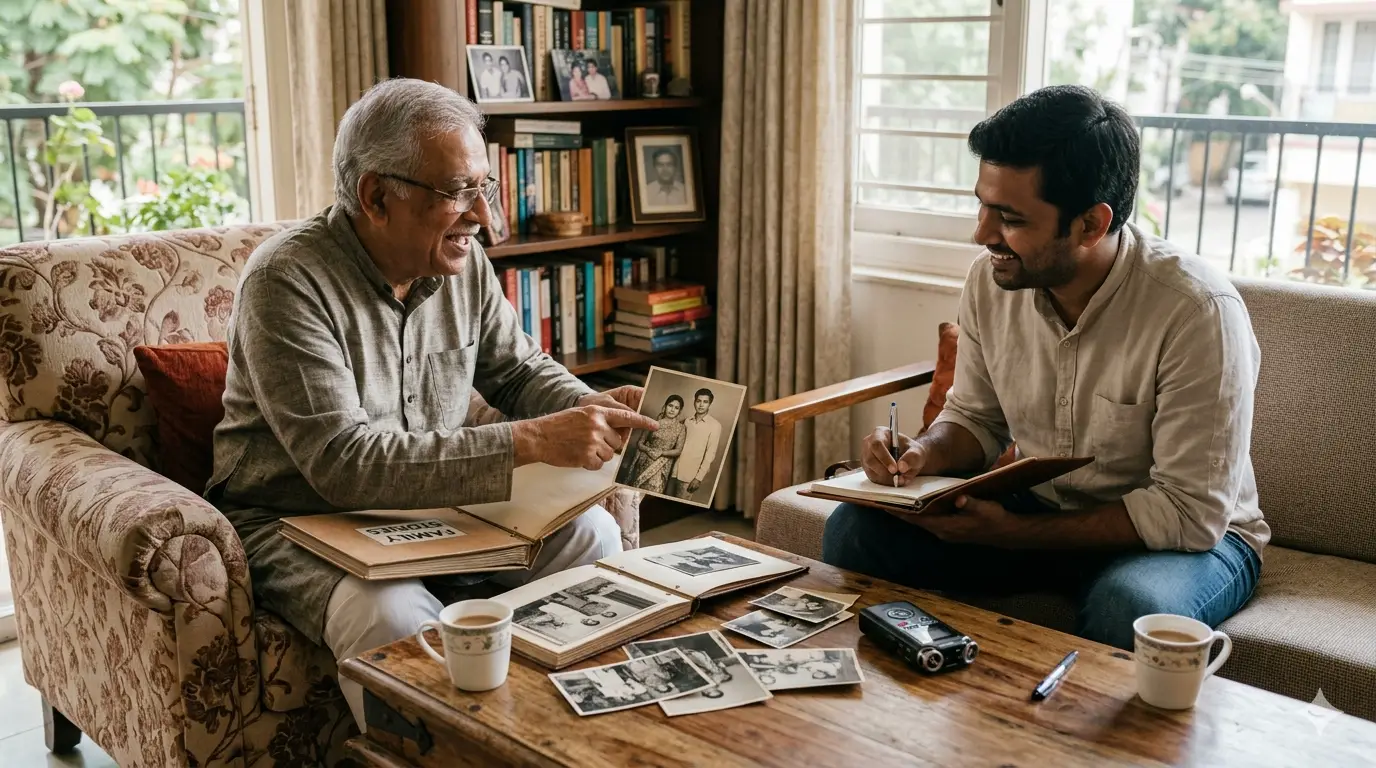
There is a story in almost every NRI family that nobody has written down yet. A grandfather who crossed the border during Partition carrying nothing but his children and a memory of the house he left behind. A grandmother who ran a household through drought, financial ruin, and the slow rebuilding of everything. A great-uncle who walked from a village in Rajasthan to Bombay in the 1950s and built a business from scratch. A family that made its way from coastal Andhra to East Africa to the United Kingdom across three generations — each leg of the journey documented only in the fading memories of elders who are getting older every year.
These are not just family stories. They are primary historical records of one of the largest diaspora movements in modern history. According to the Ministry of External Affairs, as of 2025 there are approximately 35.4 million Non-Resident Indians and Persons of Indian Origin living outside India — spread across more than 200 countries, representing the largest single-origin diaspora population in the world. Behind every one of those 35 million people is a family story. And the vast majority of those stories have never been written down.
That is changing. Quietly but unmistakably, a growing number of NRI families across the United States, the United Kingdom, Canada, Australia, the UAE, and beyond are beginning to commission family history books — and they are overwhelmingly choosing to work with Indian ghostwriters to do it. This is not just a sentimental trend. It is a response to a genuine and urgent problem: the first and second generation of major Indian emigration is ageing, and the stories they carry are irreplaceable. Once they are gone, they cannot be recovered.
The Scale of What Is Being Lost
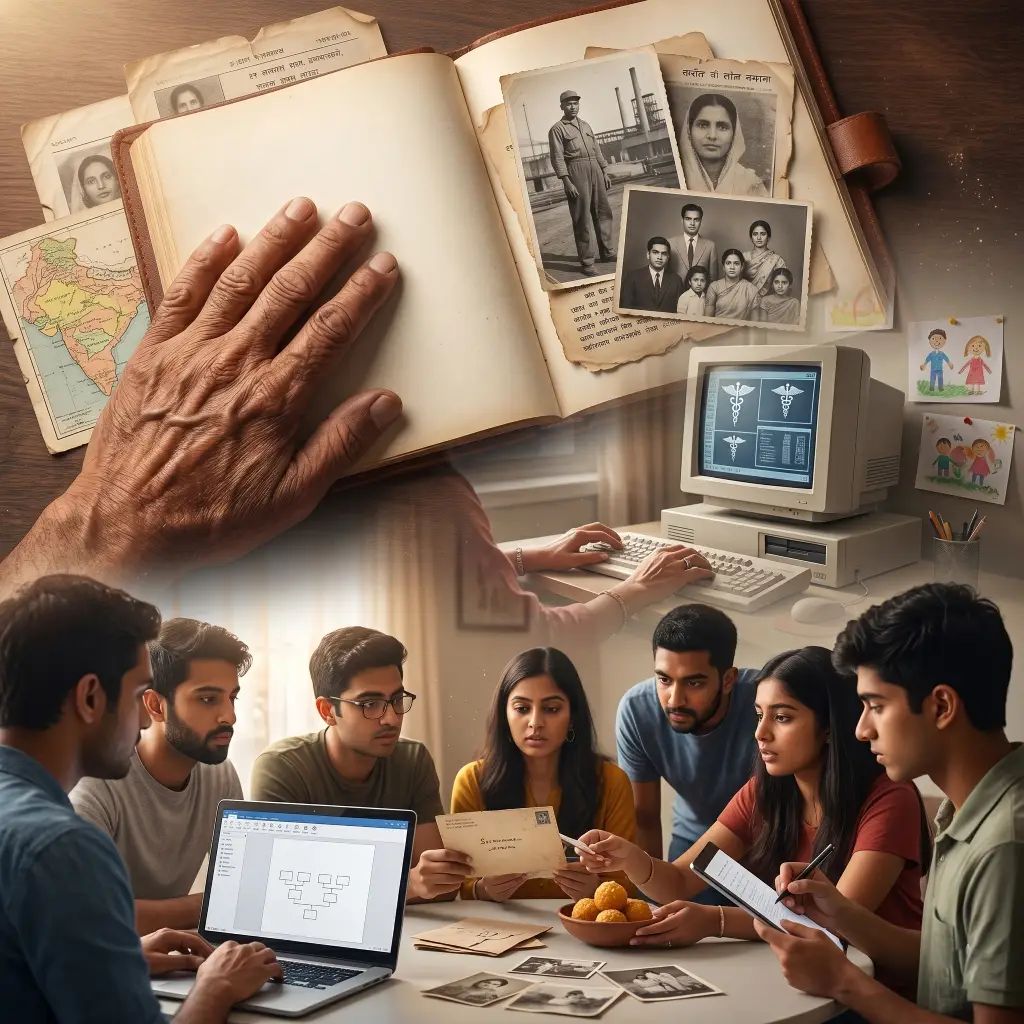
To understand why this trend is accelerating in 2026, you have to understand the timeline it is racing against. The first major wave of Indian emigration to the United Kingdom began in the 1950s and 1960s, when Indians came to fill labour shortages in British industry. The wave to the United States intensified after the Immigration and Nationality Act of 1965 opened professional migration pathways. The Gulf migration boom ran through the 1970s and 1980s. The IT-driven migration to North America and Australia accelerated through the 1990s and 2000s.
The people at the heart of these migration stories — the ones who actually lived them, who made the decision to leave, who remember what they left behind — are now in their seventies, eighties, and nineties. Their children, the second generation, were often too busy building their own careers and lives to ask the questions that now feel urgent. And the third generation — born in California, in Surrey, in Ontario, in Sydney — grew up with only fragments: a surname that gets mispronounced, a handful of photographs, a dish cooked only at Diwali, and the vague sense that there is a whole other story behind the one they know.
The genealogy and family history market has been growing steadily as more families recognise the importance of documentation before it is too late. But for Indian diaspora families, the urgency has a particular texture. Indian family histories are layered in ways that are genuinely difficult for families to unpack alone. They interweave caste, region, language, religion, colonial history, Partition, Partition’s aftermath, village records, oral traditions, family feuds, and migrations within migrations. A Western memoir service working on a template cannot navigate this terrain. A generalist freelancer on a writing platform cannot ask the right questions. An Indian ghostwriter who understands what it means when someone says their family is from “a village near Amritsar before 1947” can.
Why Indian Ghostwriters Specifically — Not Just Any Writer
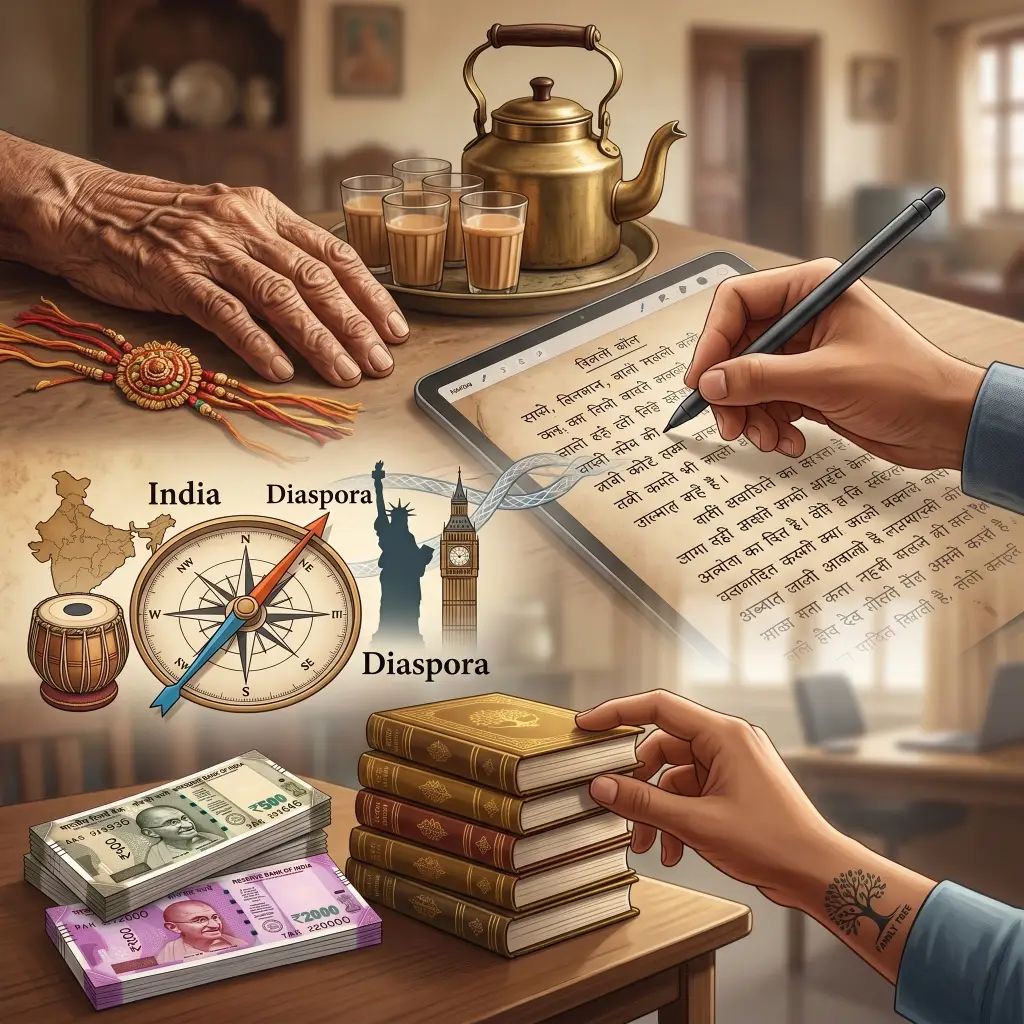
This is the question worth answering precisely, because NRI families have options. They could hire a memoir writer in the United States or the United Kingdom. They could use one of the growing number of AI-assisted memoir platforms. They could buy a guided journal and attempt the project themselves. Many have tried these paths. Most come back to the same conclusion: nobody tells an Indian family story as well as a writer who grew up inside one.
The advantages of working with an Indian ghostwriter for this kind of project are not incidental. They are structural.
Cultural fluency that cannot be taught from a briefing document. An Indian ghostwriter understands — without needing it explained — the significance of a joint family system, the particular grief of leaving a village, the way memory works in oral traditions across different regions of India, what it means to be the son who stayed and the son who left, the weight of caste in a family history even when nobody wants to talk about it directly. This is not background research. It is lived cultural knowledge. According to research on the Indian diaspora’s emotional relationship with cultural identity, second and third-generation diaspora members navigate what scholars describe as a “diasporic condition” — a state of being shaped simultaneously by the homeland they did not grow up in and the host country they did. An Indian ghostwriter understands this condition from the inside.
Bilingual and regional capability. Many of the most important stories in an NRI family history exist only in languages the second generation does not speak fluently — Punjabi, Telugu, Tamil, Gujarati, Marathi, Bengali, Hindi. An Indian ghostwriter is often able to conduct portions of an interview in the grandparent’s first language, understand the nuances of what is being communicated, and then render those stories accurately in English for the family members who will be reading the final book. No Western ghostwriting service can replicate this. A generalist AI tool produces a garbled approximation that strips out exactly the specificity and authenticity that makes the story worth keeping.
Cost that makes the project actually achievable. Indian ghostwriting services in 2026 represent what scribblersindia.com accurately describes as “value arbitrage” — mid-market rates for premium, global-standard output. A full-length family history book of 50,000 to 80,000 words with an Indian ghostwriter typically costs between ₹2.5 lakh and ₹6 lakh, depending on the scope, the number of interview subjects, and the research depth required. The equivalent project commissioned from a memoir writing firm in the United States or United Kingdom would cost anywhere from $20,000 to $60,000 or more. For most NRI families, the Indian option is not just more affordable — it is the difference between the project happening and the project remaining forever on a list of things they meant to do.
Time zone and communication compatibility. Many NRI families maintain close relationships with elderly relatives still living in India — grandparents, uncles, aunts who hold the oldest parts of the story. An Indian ghostwriter can coordinate directly with these family members in their cities, in their language, on a schedule that suits their lifestyle, without requiring international phone calls at difficult hours or expensive visits. For a family in Toronto trying to document the stories of an eighty-year-old grandmother living in Hyderabad, having a ghostwriter who can visit her, sit with her over chai, and ask the questions that matter is not just convenient — it is the only way the project actually gets done well.
What These Family History Books Actually Contain
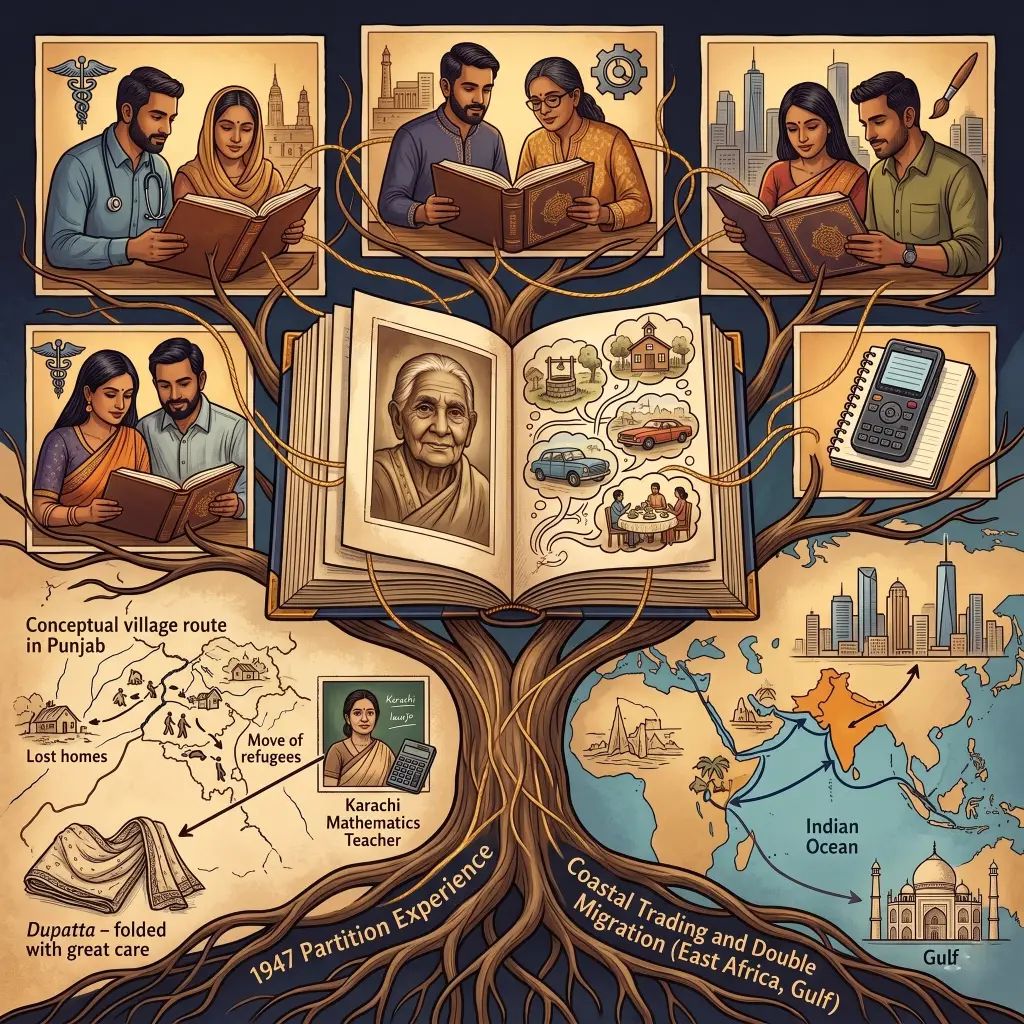
NRI families commissioning these projects are not simply writing down dates and names. The family history books that Indian ghostwriters are producing for diaspora clients in 2026 are rich, layered documents that function simultaneously as personal memoir, oral history, cultural record, and legacy gift.
A typical project might begin with the oldest living family member — a grandparent or great-grandparent — and work backwards through family records, forward through migration, and sideways through the stories of siblings and cousins whose paths diverged across different countries. The best projects weave together multiple narrative threads: the pre-migration world the family left behind, the experience of migration itself, the early years in a new country, the building of a new life, and the way family values and culture have been carried or transformed across generations.
For families whose histories involve the 1947 Partition of India, these books often become the only written record of what the family experienced — the village names, the routes, the losses, the survival. For families from coastal trading communities who settled across East Africa, the Gulf, or Southeast Asia before their children eventually migrated again to the West, these histories capture layers of displacement and adaptation that span a century or more.
For second and third-generation NRIs — those who grew up in Birmingham or Houston or Melbourne without ever having lived in India — these books serve a specific and urgent identity function. Research on identity formation among second-generation Indian diaspora communities consistently shows that the most powerful connection to cultural heritage comes not from general knowledge about India but from specific stories about specific ancestors. Knowing that your great-grandmother was a mathematics teacher in Karachi before 1947, that she taught herself Urdu to connect with her students, that she carried a specific dupatta as her only material memory of that life — that kind of specific, humanising detail is what an Indian ghostwriter, working across multiple interviews with multiple family members, can recover and preserve.
The Project Process: What Families Should Expect
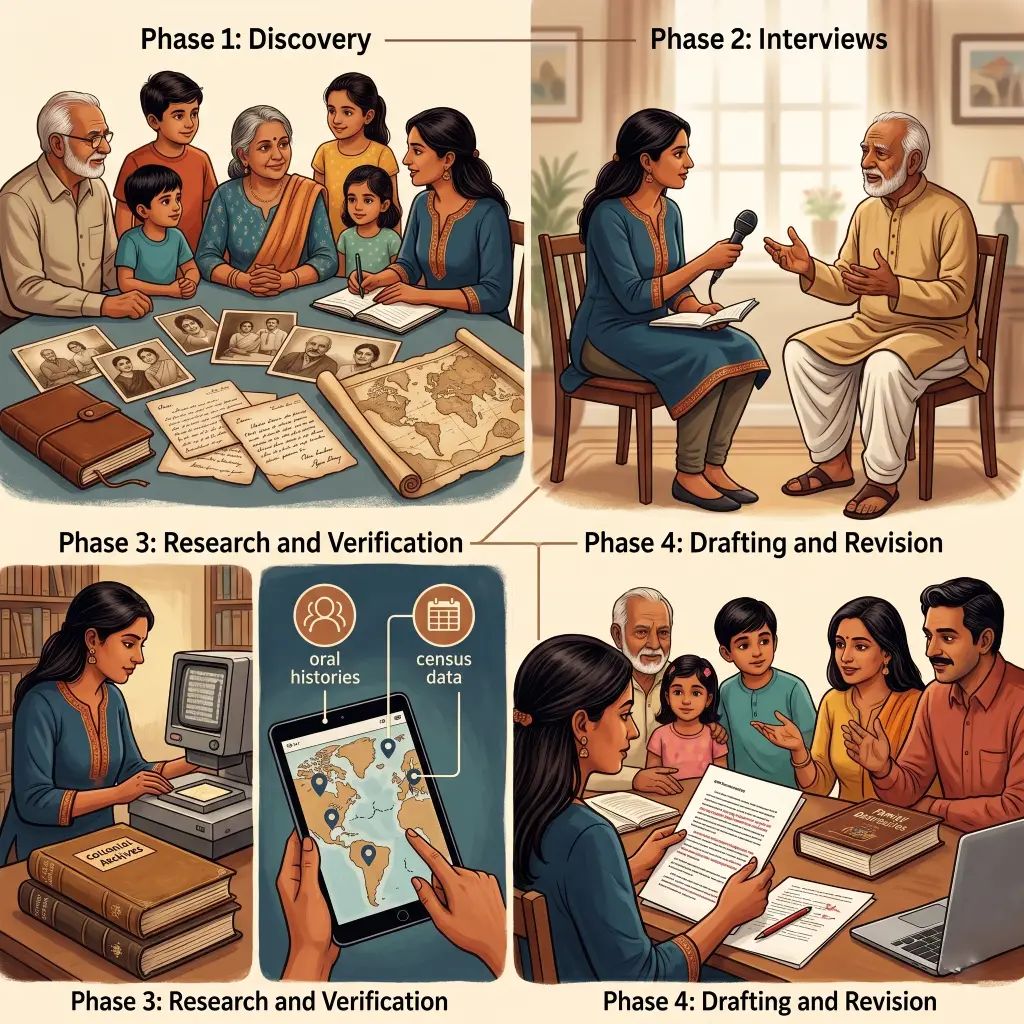
A well-run family history ghostwriting project follows a clear structure that NRI families, often coordinating across multiple time zones, need to understand before they begin.
The first phase is discovery and scoping. A good Indian ghostwriter — or the agency placing them — will spend time with the commissioning family understanding the scope of the project: how many generations to cover, how many interview subjects are available, what documentary materials exist (photographs, letters, diaries, official records), whether any research in archives or ancestral villages will be required, and what the final format should be. A private printed book for family distribution is the most common format. Some families want a digital version shared across the diaspora. Others want both.
The second phase is interviews. This is the heart of the project, and it is where the choice of ghostwriter matters most. A skilled interviewer — particularly one with cultural fluency — can draw out stories that subjects never thought worth telling. They know how to sit with silence. They know how to ask a question about a place in a way that opens up an era. They know how to follow a thread about a person until the specific, luminous detail emerges that brings the whole story to life. Many of the best stories in any family history are the ones the family almost did not share, the ones that started as “oh it was nothing really” and ended up being the chapter everyone reads twice.
The third phase is research and verification. Indian ghostwriters working on family histories for NRI clients often conduct supplementary research — in regional archives, in colonial-era records held at the National Archives of India, in land records, in census data, in the oral histories of specific communities — to provide context, verify dates, and fill in gaps that personal memory alone cannot close. The Families in British India Society, FamilySearch’s India genealogy records, and Ancestry.com’s India record collections are among the resources that supplement interview-based research, particularly for families tracing ancestry through the colonial period.
The fourth phase is drafting and revision, which follows the same structured process as any professional ghostwriting engagement: outlined structure agreed with the family, milestone-based drafting, family review at each stage, and revision rounds until the narrative feels right. The best Indian ghostwriters working in this space understand that a family history book is not edited in the same spirit as a commercial book — the family’s sense of emotional truth matters as much as literary polish, and the two are not in conflict.
What the Second Generation Is Looking For
It is worth being specific about who is actually commissioning these projects, because the motivations are more varied and more interesting than simple nostalgia.
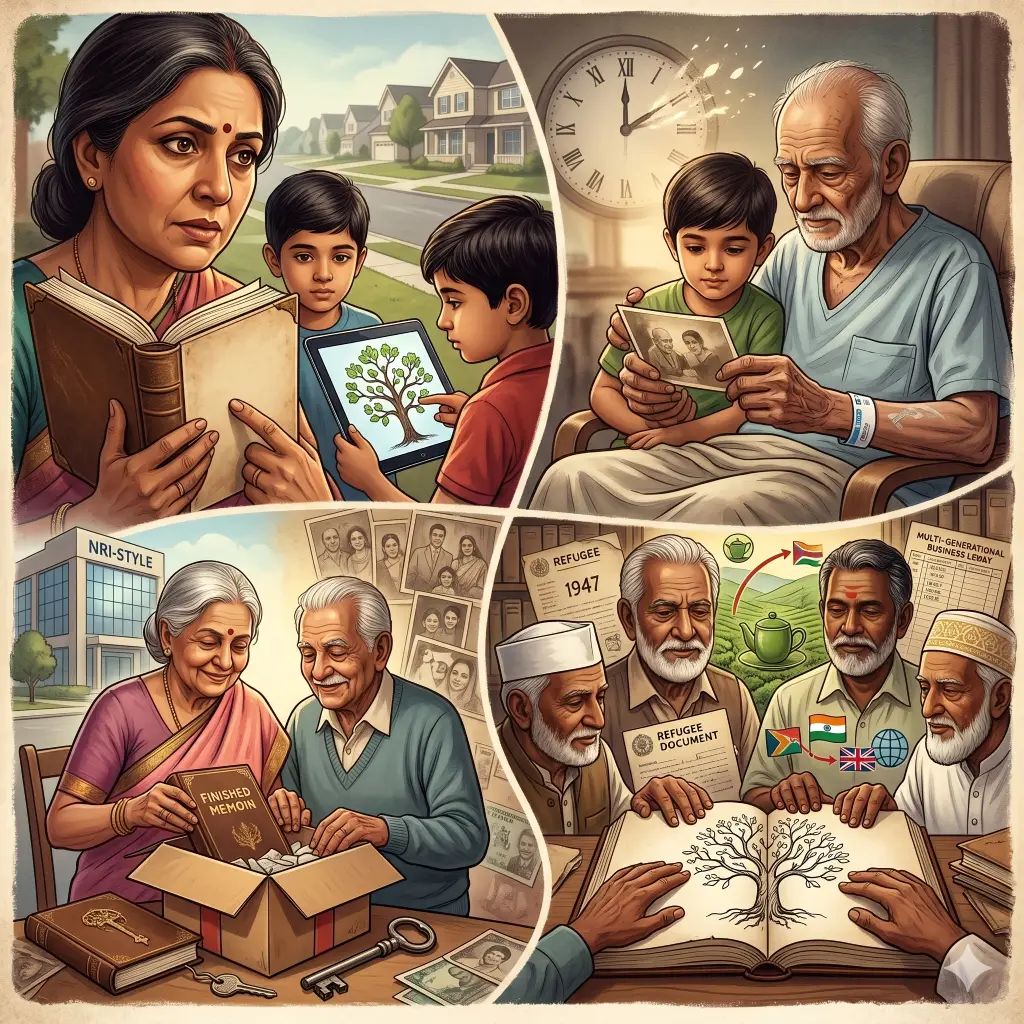
Some projects are initiated by the second generation — adults in their forties and fifties who have reached the point in their own lives where the question of roots feels urgent. Their children are growing up as third-generation diaspora, further from India in every way, and they want to give them something concrete — a book they can hold, a story they can trace, an identity that is specific rather than general.
Some projects are initiated in response to the death or declining health of a grandparent. The realisation that a particular person is the last living holder of a specific part of the family’s story creates a very focused motivation to act quickly. Several of the families who contact Ghostwriting India describe beginning their project after a close call with a grandparent’s health — the moment when it became clear that “someday” was not going to be available for much longer.
Some projects are initiated by the first generation itself — NRIs in their sixties and seventies who want to leave something behind for their children and grandchildren, who have spent their working lives building financial security and now want to build something that money cannot buy.
And some projects are initiated for cultural and archival reasons — an understanding that certain Indian communities whose histories have been inadequately documented — Sindhi refugees of 1947, Tamil workers who migrated to Sri Lanka and then on to the United Kingdom, Bohra trading families who built businesses across East Africa — deserve a serious written record, and that the people best placed to create it are ageing.
Why This Work Belongs to a Specialist
A family history book is not the same as a standard memoir, and the distinction matters when choosing a ghostwriting service. A standard memoir centres one life and one narrative arc. A family history weaves together multiple lives, multiple timelines, multiple perspectives, and often multiple languages and cultural registers. The writer needs to make structural decisions — about chronology, about point of view, about how to handle conflict and painful history with honesty and sensitivity — that require both craft and judgment.
This is exactly the kind of work that Ghostwriting India specialises in. Our nonfiction book ghostwriting services include family history and memoir projects designed specifically for NRI families who want to document their heritage with the seriousness, cultural accuracy, and literary quality it deserves. Our writers conduct interviews in English and in multiple Indian languages, coordinate with family members across time zones, and produce manuscripts that families describe as feeling immediately, unmistakably true — like hearing a story told in exactly the right voice for the first time.
We also handle the full range of formats these projects take: a comprehensive nonfiction book spanning multiple generations, a focused personal memoir of a single grandparent’s life, a shorter ebook distributed digitally across the family, or a manuscript delivered for self-publication through Amazon KDP or a specialist heritage printer. The choice of format shapes the scope and cost of the project, and our team guides families through those decisions at the start of every engagement.
A Word on Timing
The most common regret families express when they begin a family history project is that they did not start sooner. The most common reason they delayed is that the project felt too large, too open-ended, and too emotionally charged to begin. A skilled ghostwriter removes all three of those obstacles. They scope the project, they structure the process, and they manage the interviews with the sensitivity that emotionally significant stories require. What feels like an impossible undertaking becomes, with professional support, a structured, milestone-based project that produces a finished book within six to twelve months.
The grandparent who still remembers the name of the street they grew up on, the sound of the call to prayer from the mosque two houses down, the taste of the halwa their mother made only at Eid — that person is a living archive. Every year that passes without documentation is a year of irreplaceable material lost. This is not a project that benefits from waiting.
If you are an NRI family with stories that need to be preserved and you are ready to start the conversation, Ghostwriting India’s team is here to help.
The stories that NRI families carry are some of the most extraordinary of the twentieth and twenty-first centuries — stories of movement, sacrifice, survival, reinvention, and the complicated, irreducible love of people for the places and communities they came from. They deserve to be told well, told accurately, and told in a form that will survive.
An Indian ghostwriter is not just a practical choice for this work. For most NRI families, they are the only choice that can actually do the project justice — bringing the cultural intelligence, the linguistic range, the historical awareness, and the human sensitivity that these stories require.
If your family has stories that have never been written down, and if the people who carry them are getting older, this is the year to begin. Ghostwriting India is ready to help you do it properly — across family history books, personal memoirs, ebook formats, and full-length manuscripts. Start the conversation today.


