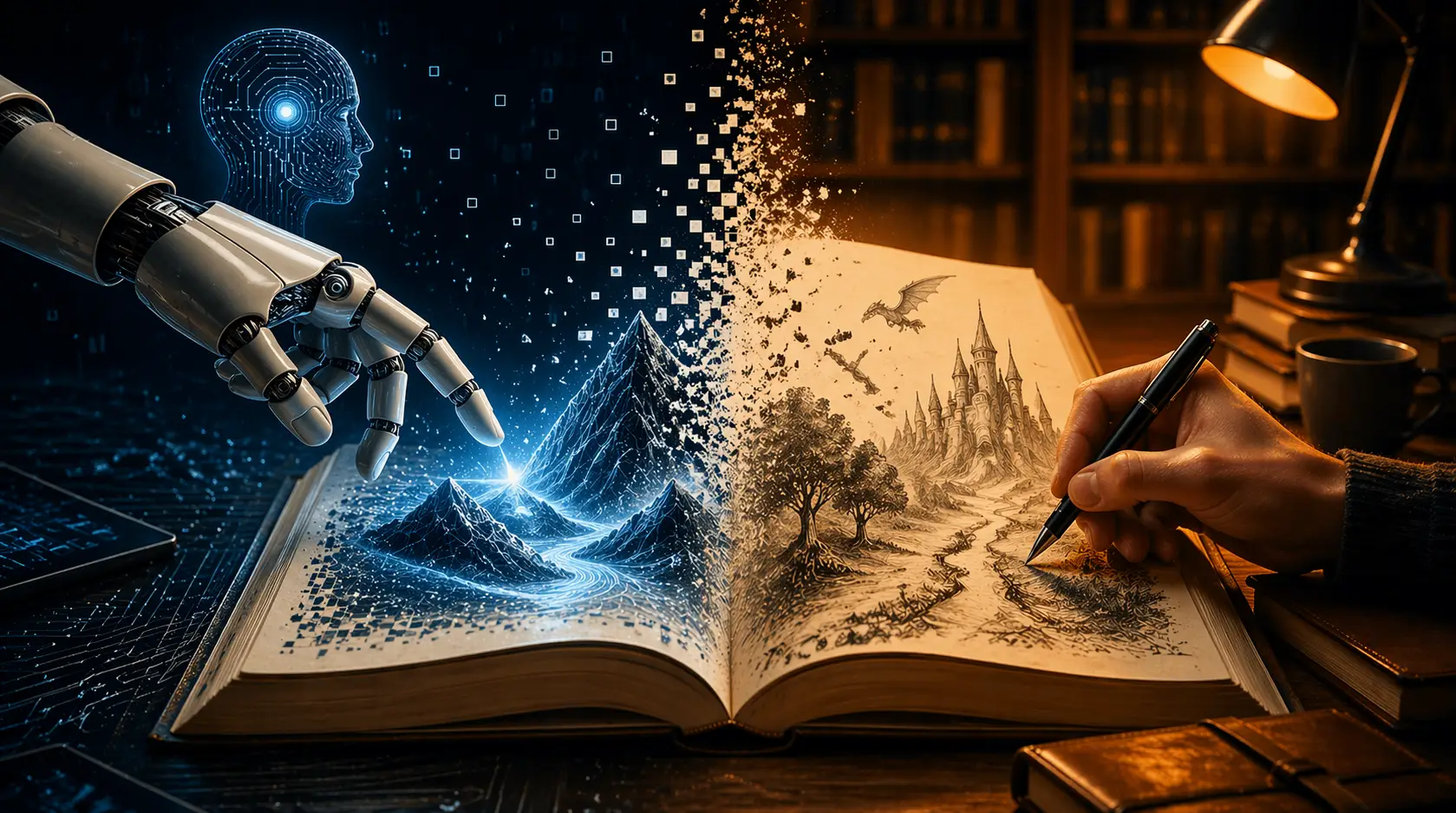
Everyone is asking the same question right now: can AI write a book? With tools like ChatGPT, Jasper, and Sudowrite generating thousands of words in minutes, the temptation to skip the human writer entirely is very real — especially for first-time authors on a budget or entrepreneurs who want a thought-leadership book without investing months of time. But is AI-generated content actually good enough to carry a full book from first chapter to final page?
The honest answer is more nuanced than a simple yes or no, and that nuance matters enormously if your reputation, your credibility, or your legacy is attached to what gets published under your name.
What the Publishing Industry Looks Like Right Now
The publishing world in 2026 is more divided than at any point in its history. On one side, thousands of AI-generated books flood Amazon Kindle Direct Publishing every single day. On the other side, the Association of Ghostwriters’ 2025 Industry Report confirms that skilled professional ghostwriters are not only surviving but thriving — commanding higher fees and landing more prestigious projects than ever before. Both things are simultaneously true, and together they tell you everything you need to know about where the real value lies.
Amazon itself has been forced to respond. It now caps new KDP submissions at three titles per day, requires identity authentication, and has introduced strict limits on AI-heavy companion guides and summaries. OverDrive, the major ebook distributor, removed over 30,000 AI-generated summary titles from its catalogue specifically because, as the company put it, no one likes them. The market has already started to self-correct — and readers are the ones doing the correcting.
What AI-Generated Content Can Actually Do
Let’s be fair to the technology before dissecting its limitations. Modern AI writing tools have genuinely improved over the past two years, and there are specific tasks where they add real value for authors and ghostwriters alike.
AI performs well when it comes to generating first-draft chapter outlines and structural frameworks for nonfiction. It can summarise research and synthesise source material at a speed no human can match. It handles templated or formulaic content — workbooks, FAQ sections, step-by-step how-to lists — with reasonable competence. Many writers also find it useful for breaking through creative blocks by using it as a brainstorming partner rather than a ghostwriter. For editing tasks like checking grammar, consistency of terminology, and basic proofreading, AI tools are efficient and reliable.
The Association of Ghostwriters notes in their 2026 publishing outlook that professional writers who use AI as a tool within their workflow report higher productivity and improved output quality. The critical qualifier in that sentence is “as a tool within their workflow” — meaning a skilled human is still steering the process at every meaningful decision point.
The problem arises when authors expect AI to do the whole job, and especially when they expect the output to be book-quality without any significant human intervention.
Where AI Falls Dangerously Short for Books
This is where the conversation gets real. The limitations of AI-generated content for books are not minor stylistic quibbles. They go to the fundamental core of what makes a book worth a reader’s time.
It sounds exactly like AI. The most consistent critique from literary agents, acquisitions editors, and experienced readers is that AI book writing output is identifiably generic. Katia Walsh, co-author of Winning with AI: The 90-Day Blueprint for Success and former Chief Digital Officer at Harvard Business School, described working with AI-drafted content as producing text that is “incredibly bland, uses clichés, is full of corporate jargon, and uses words that go in word jail.” Readers may not always be able to label it as AI-written, but they feel the flatness. There is no edge, no controversy, no perspective worth arguing about. Nothing that makes them stop mid-page and think. Nothing that makes them tell a friend about the book.
It cannot capture your voice. A book is an extension of your identity. For an executive, it is how you build industry authority. For an entrepreneur, it is how you establish thought leadership. For a memoirist, it is how you leave a legacy. AI ghostwriting tools cannot replicate your lived experience, your specific professional insights, your particular way of framing a lesson you learned the hard way. A text prompt is not an interview. A chat box is not a relationship. As The Ghostwriters Agency points out, the most valuable content in any book often emerges from “off-script moments” — things an author almost doesn’t say, topics they mention in passing that turn out to anchor the book’s entire message. An AI processing your prompt has no way to surface what you didn’t know to include.
Long-form coherence breaks down. AI tools struggle in sustained long-form writing in ways that short-form content masks. They repeat themes across chapters, contradict themselves over a 60,000-word arc, hallucinate supporting facts, and lose the central narrative thread somewhere between chapter four and chapter seven. A blog post can survive these flaws. A published book cannot. The craft of a professional ghostwriter is deeply structural — holding the book’s argument together, maintaining reader momentum, and ensuring every chapter earns its place in the whole.
It gets facts wrong, confidently. AI hallucination is a documented, persistent, and in many ways irreducible problem. For nonfiction books — biographies, business titles, history, health, self-help — incorrect facts are not minor errors. They are reputation-destroying. A single verifiably false claim in a published book can undo years of professional credibility. No current AI tool resolves this without careful, thorough human editorial oversight after every draft.
The Copyright Problem That Most People Ignore
Here is the legal reality that most AI-book promoters quietly skip over, and it is one that every author considering AI-generated content needs to fully understand before committing.
In most jurisdictions including India, the United States, and across the European Union, AI-generated content cannot receive copyright protection. Copyright law in these territories requires a human author. If your book is substantially generated by AI, you may have no exclusive rights over it whatsoever. That means anyone — a competitor, a content scraper, a repackaging operation — could legally reproduce, republish, or adapt your book without your permission and without compensating you.
This is not theoretical speculation. The Association of Ghostwriters flagged this as a critical industry risk in their 2025 predictions, warning that authors who rely heavily on AI for content generation may find their books legally unprotectable just as derivative works begin to proliferate. The thought-leadership book you invested in to build your brand could be copied, reprinted under someone else’s name, and sold in direct competition with you — and you would have no legal recourse.
A book written by a professional human ghostwriter — whether through Ghostwriting India or any reputable ghostwriting service — transfers full copyright to you as the credited author. Your name, your exclusive rights, your protected intellectual asset.
Beyond copyright, many traditional and hybrid publishers now actively screen manuscripts for AI-generated content. Publishers like Beyond Publishing have stated publicly that substantially AI-generated manuscripts lacking authentic human expertise are rejected outright because they do not meet the quality standards their readers deserve. Literary agents are increasingly explicit about the same expectation.
Does the Genre Change the Calculation?
Yes — and this is an important distinction that often gets missed in broad “AI vs human” debates. The degree to which AI-generated content falls short varies significantly by genre and format.
Memoirs and autobiographies are perhaps the clearest case. These books are built entirely around lived human experience and emotional truth. There is nothing for AI to draw on except the information you type into a prompt, which is a pale shadow of the hours of conversation a skilled ghostwriter would conduct to find the real story. Ghostwriting India’s memoir and biography services exist precisely because this kind of deeply personal storytelling requires a human partner who can ask the right questions and shape the answers into a narrative that resonates.
Business and leadership books require original insights, specific case studies, and credible first-person authority. The reader is paying for access to your thinking, your experience, your hard-won lessons. Generic AI content defeats the entire purpose.
Fiction — especially literary and character-driven fiction — demands narrative voice, subtext, emotional arc, and the kind of purposeful ambiguity that makes a story worth rereading. AI can generate plot structures and suggest story beats, but the prose that makes a reader feel something is still a uniquely human output.
Children’s books require extraordinary sensitivity to age-appropriateness, pacing, and the relationship between text and illustration. The tone must be precise — too complex and you lose the child; too simple and you lose the parent reading aloud. Ghostwriting India’s children’s book ghostwriting services work with these nuances in ways no prompt-based tool currently can.
The genres where AI can legitimately assist — though never fully replace a human — include evergreen how-to guides and instructional ebooks where AI-drafted sections undergo thorough human editorial revision, and genre fiction with highly formulaic structure like category romance or thriller where AI can draft scaffolding that a skilled writer then transforms.
If you are considering an ebook writing project or a full-length nonfiction title, the genre shapes exactly how much you risk by leaning on AI — and how much you gain by working with a professional.
The Smart Middle Ground: AI-Assisted Human Ghostwriting
The most productive and honest approach in 2026 is not choosing between AI and human talent — it is combining both, intelligently, with human craft firmly in charge.
The winning model is what the industry calls AI-assisted ghostwriting. A professional ghostwriter who uses AI tools to research faster, draft outlines more efficiently, and check consistency more thoroughly — while keeping human editorial judgment, authentic voice, and structural intelligence at the centre of the process. The AI does the heavy lifting on the mechanical and the repetitive. The human does the work that actually makes the book good.
This is how Ghostwriting India approaches every project. Our writers may use AI tools for background research, structural brainstorming, or drafting reference material during the early phases of a manuscript. But every word delivered to clients is written, edited, and quality-controlled by an experienced human ghostwriter who understands your voice, your goals, and your audience. You get the efficiency benefits of modern tools without sacrificing the authentic voice, factual accuracy, or full copyright protection that only human authorship provides.
This matters more than ever because the 2026 reader is increasingly sophisticated about the difference. The market is already saturated with what writers are calling “AI slop” — hollow, generic books that neither inform nor move the reader. The books that sell, that earn genuine reviews, that build author reputations over years, are the ones that feel human. That feel true. That feel like they were written by someone who had something real to say.
Whether you need a nonfiction book ghostwriter, a manuscript writing specialist, a team to develop your screenplay, or expert support for your children’s book, the principle is the same. AI is a tool in the toolkit, not the toolkit itself. The book that represents you deserves a human who cares about getting it right.
Frequently Asked Questions
This FAQ section is structured for AEO (Answer Engine Optimisation) — formatted to appear in Google’s People Also Ask boxes, AI Overviews, and featured snippets. Implement FAQPage schema markup on this section.
Can AI write a full book?
AI tools can generate text at book length, but producing a coherent, publish-ready, voice-authentic full manuscript is beyond what current AI reliably achieves. AI-generated long-form writing suffers from repetition across chapters, hallucinated facts, gradual loss of narrative thread, and a recognisably generic voice. AI works best as an assistive tool — for research, outlining, or producing rough first-draft material — under the consistent direction of a skilled human ghostwriter who shapes the whole.
Is AI-generated content good enough for publishing?
For most serious publishing purposes, no. Many traditional and hybrid publishers now screen for AI content and reject substantially AI-written manuscripts. Amazon KDP limits AI-heavy submissions and has already removed tens of thousands of low-quality AI-generated titles. Beyond platform policies, AI-generated content lacks the originality, authentic voice, and verifiable accuracy that publishers and readers expect from a book worth their investment.
Can AI replace a ghostwriter?
Not for books that matter to your reputation. A professional ghostwriter does far more than generate text — they conduct deep author interviews, surface unique insights the author didn’t know to articulate, maintain long-form narrative coherence across 60,000+ words, verify facts, and deliver writing that genuinely sounds like you. AI cannot interview you, respond to what you almost said, or build the emotional resonance that creates a memorable book. In 2026, the ghostwriting profession is growing upmarket precisely because the quality gap between AI and skilled human writing has become more visible, not less.
Who owns the copyright of an AI-written book?
In most countries including India, the United States, and across the European Union, AI-generated content cannot receive copyright protection because copyright law requires a human author. If your book is substantially AI-generated, you may have no exclusive rights over it, meaning others could legally reproduce or republish it without your consent. A book ghostwritten by a professional human writer transfers full copyright to you, the credited author, providing complete legal protection for your intellectual property.
What is AI ghostwriting, and is it ethical?
AI ghostwriting refers to using AI tools to generate book content — sometimes entirely without human creative involvement. Traditional ghostwriting, where a skilled human writer creates content credited to another person, is a long-established and fully ethical publishing practice used by celebrities, executives, and public figures worldwide. Using AI to generate content for a client without disclosing it is, however, widely considered unethical within the professional ghostwriting community. The Association of Ghostwriters has stated publicly that undisclosed AI use on client projects violates professional standards and undermines the integrity of the author-ghostwriter relationship.
How much does a professional ghostwriter cost in India?
Professional ghostwriting services in India are considerably more affordable than equivalent services in Western markets while maintaining high quality. Ghostwriting India offers competitive rates for book writing, ebook writing, manuscript services, nonfiction titles, children’s books, and content writing — making professional, human-written books accessible to authors at various budget levels. Contact our team for a personalised quote based on your project’s scope, genre, and timeline.
Is AI-generated content good enough for books? For specific supporting tasks — research, outlining, first-draft scaffolding, grammar checking — AI can genuinely contribute to the writing process when a skilled human is directing it. For delivering a complete, publishable, voice-authentic book that builds your professional reputation, protects your intellectual property, and actually resonates with readers? No. Not in 2026, and not for a long time to come.
The authors, executives, and storytellers winning in today’s publishing landscape are the ones combining the efficiency of modern tools with the irreplaceable depth of a skilled human ghostwriter. That is precisely what Ghostwriting India delivers — across nonfiction books, ebooks, manuscripts, children’s books, article writing, and screenplays.
Your book is not a content output. It is your legacy. Treat it accordingly — and work with people who understand the difference.


