
At our ghostwriting studio, we review dozens of manuscripts every month, and one pattern shows up again and again: brilliant stories get overlooked simply because the formatting isn’t right. A strong book manuscript formatting guide isn’t just a nice-to-have it’s often the difference between a manuscript that gets read and one that gets rejected before the first chapter even opens.
Today, we’re breaking down exactly how to format a book manuscript so it meets industry expectations, whether you’re submitting to literary agents, publishers, or preparing a file for self-publishing. We’ll walk through fonts, spacing, chapter breaks, title pages, and the small details that signal professionalism to anyone reading your work.
By the end of this guide, you’ll have a clear, repeatable formatting checklist you can apply to any manuscript you write.
Why Manuscript Formatting Actually Matters

Before we get into specifics, it’s worth understanding why this topic deserves attention in the first place.
Agents and editors read hundreds of submissions a month. When a manuscript arrives in a nonstandard format unusual fonts, inconsistent spacing, missing page numbers it creates friction before the content is even evaluated. We’ve seen well-written manuscripts get passed over simply because they were harder to read than they needed to be.
Proper formatting does three things for you:
- It signals that you understand industry norms, which builds credibility from page one
- It makes your manuscript easier to read, edit, and evaluate
- It shows respect for the reader’s time, which matters more than most writers realize
This is one of the reasons we always recommend nailing down formatting early, alongside foundational elements like structure. If you’re still working through your book’s core narrative, our book writer guide is a useful starting point before you finalize your manuscript’s layout.
Book Manuscript Formatting Tips: The Essentials
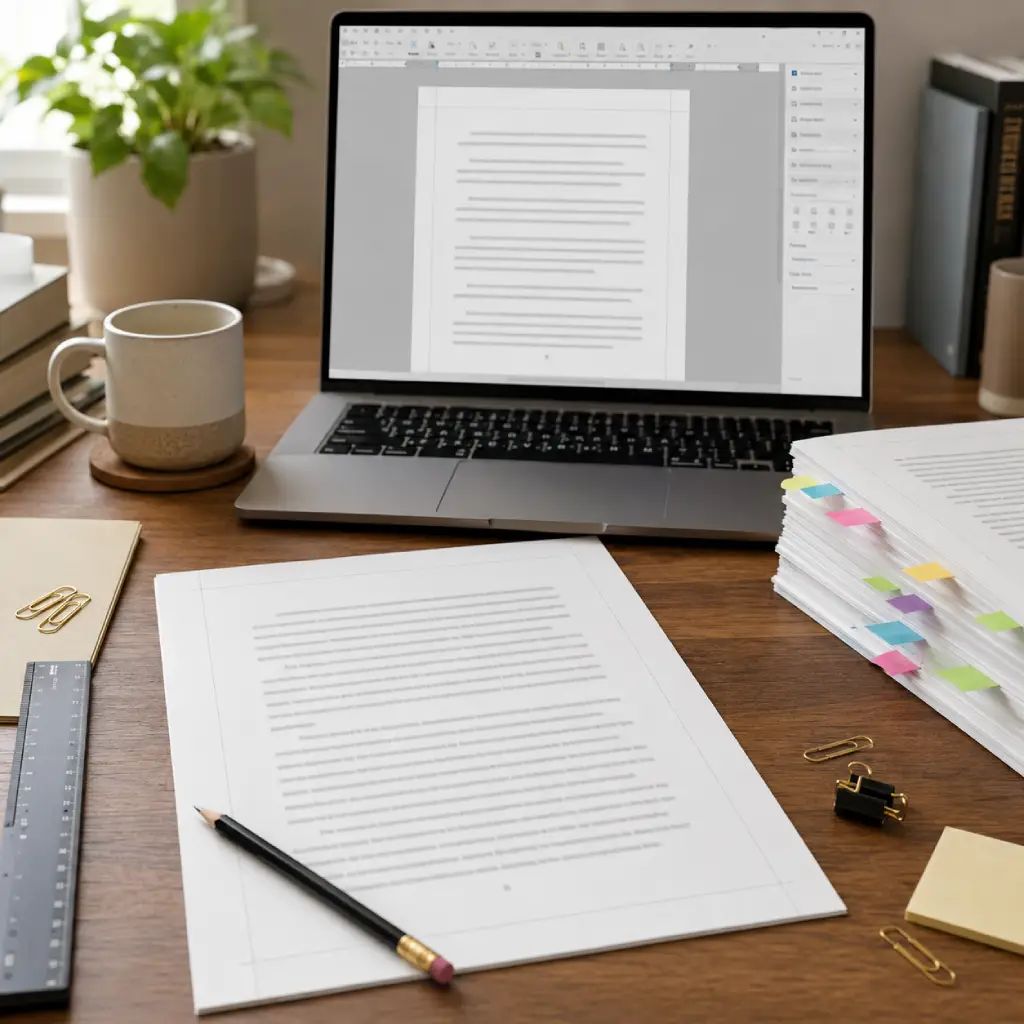
Let’s start with the non-negotiables. These are the formatting tips that apply to nearly every fiction and nonfiction manuscript, regardless of genre.
Font and Font Size
Stick to a standard, readable serif font. Times New Roman at 12-point size remains the industry default, and for good reason – it’s easy on the eyes across long reading sessions and prints predictably. Courier New is sometimes accepted for screenplay-adjacent formats, but for books, Times New Roman is the safest choice.
Margins and Spacing
Use one-inch margins on all sides. Double-space the entire manuscript, including dialogue and block text. Avoid adding extra space between paragraphs instead, indent the first line of each paragraph by 0.5 inches using the paragraph settings, not the tab key or spacebar.
Alignment
Left-align your text rather than justifying it. Justified text creates uneven spacing between words, which can slow down reading and looks less professional in manuscript form, even though it’s common in published books.
Structuring Your Chapters Correctly
Chapter structure is where a lot of writers lose points unnecessarily.
Starting New Chapters
Each new chapter should begin on a fresh page, roughly a third of the way down. Center the chapter title or number, and use a consistent format throughout for example, “Chapter One” versus “Chapter 1,” but never both within the same manuscript.
Scene Breaks
Within a chapter, use a simple scene break indicator like a centered “#” or “***” to signal a shift in time, location, or point of view. Keep this consistent throughout the entire manuscript.
If your book relies heavily on interwoven storylines, getting these transitions right becomes even more important. Our subplot creation guide covers how to structure multiple narrative threads without confusing the reader – which pairs directly with clean chapter and scene formatting.
Title Page and Header Requirements
Your title page sets the first impression, so it deserves careful attention.
What Belongs on the Title Page
Include your name (or pen name), contact information, and a word count estimate in the upper corners. Center the book’s title and your byline in the middle of the page. Skip decorative fonts, images, or colors a title page should be clean and purely informational.
Running Headers
From chapter one onward, most agents expect a running header containing your last name, the book title (or a shortened version), and the page number, typically placed in the upper right corner of each page.
Formatting for Fiction vs. Nonfiction Manuscripts

While the core rules above apply broadly, fiction and nonfiction manuscripts have a few distinctions worth noting.
Fiction Manuscripts
Fiction generally follows the standard formatting rules closely, with particular attention paid to dialogue formatting each new speaker gets a new paragraph, and punctuation stays inside quotation marks. If you’re working on a genre with tight pacing demands, like mystery or thriller writing, formatting consistency becomes especially important for readability. Our mystery novel writing tips guide touches on pacing considerations that tie directly into how chapters and scenes should be laid out.
Nonfiction Manuscripts
Nonfiction often includes additional structural elements: a table of contents, section headings within chapters, footnotes or endnotes, and sometimes an appendix or index. If your nonfiction project involves heavy source material, formatting citations correctly from the start will save significant editing time later. Our nonfiction book research guide walks through organizing research in a way that translates cleanly into manuscript form.
Common Formatting Mistakes to Avoid
Through years of reviewing manuscripts, we consistently see the same handful of errors:
- Using multiple fonts or font sizes throughout the document
- Adding manual page breaks instead of using proper chapter break settings
- Using tabs or spaces instead of paragraph indentation settings
- Forgetting to number pages consistently
- Mixing single and double spacing across different sections
Each of these seems minor individually, but together they create a manuscript that reads as unpolished, regardless of how strong the writing itself is.
Frequently Asked Questions
What is the standard font for a book manuscript?
Times New Roman, 12-point, is the accepted industry standard for fiction and nonfiction manuscripts submitted to agents or publishers.
Should I single-space or double-space my manuscript?
Always double-space your manuscript. This gives editors and agents room to make notes and makes the text easier to read during evaluation.
Do I need a table of contents for a novel?
No, fiction manuscripts typically don’t include a table of contents. This is generally reserved for nonfiction books, especially those organized by topic or section.
How should I format chapter titles?
Center chapter titles, place them about a third of the way down a new page, and keep the format consistent throughout don’t switch between numbering styles.
Does formatting really affect whether my manuscript gets accepted?
While strong writing is what ultimately gets a manuscript accepted, poor formatting creates unnecessary friction and can make a submission harder to evaluate fairly, especially in competitive submission piles.
Formatting your manuscript correctly isn’t about creativity it’s about removing obstacles between your writing and the people who need to read it. Once you’ve internalized these standards, applying them becomes second nature, and you can focus your energy where it matters most: the story itself.
If you’d like expert eyes on your manuscript before you submit it, our team can help you polish both the formatting and the content itself. Visit Ghostwriting India to learn more about our manuscript editing and ghostwriting services.


