
Welcome to today’s blog where we are going to help solve the confusion that has always been there with people and we are going to help you understand the differences between these two terminologies in writing.
We are of course talking about ghostwriting and co-authoring.
The thing with these two words is that they get misunderstood a lot and they mean something completely different and if you are an author then you should know about the differences.
It will also help you a lot to understand their differences if you are planning on being an academic or a business leader or any kind of person associated with books and literature because these concepts are fundamental.
The reason why these two terms get confused a lot is because sometimes they are utilised interchangeably which means they even get used wrong in official places.
So, what do these mean? Let’s find out.
What Is Ghostwriting?

Understanding what is ghostwriting is actually a very simple concept to grasp because you need to stop thinking about it as a type of writing technique and you need to think of it as a service.
Let me help you with an example.
Let’s say you are a business professional and you need a lot of content for your business website whether it is product descriptions, website page content or even business literature. You can decide to write it on your own but that would not be professional.
Instead, you choose to have it written by a professional. That professional is a ghostwriter.
The same might be the case if you want to write a book but you do not have any experience or time to write that book. You would want a reliable professional who would do the job for you and also not take credit for it.
Then again, the professional you might need will be a ghostwriter.
A ghostwriter simply means a professional writer who is willing to write any and every kind of content for you in exchange for payment.
This means the scope of working with a ghostwriter is huge.
The Characteristics of Ghostwriting Include:
No Public Credit: The ghostwriter can under no circumstances claim the content because anonymity is itself a part of the service contract.
Client Ownership: Only the client owns the rights to the content and is credited as the author.
Extensive Collaboration: The collaboration between the ghostwriter or ghostwriting agency and the client can be extensive which means interviews, collection and utilisation of study material and the adoption of the client’s voice and style.
Wide Usage: The services of ghostwriters can be utilised everywhere from books to online web content to scripts as well as autobiographies and speeches and much more.
What Is Co-Authoring?
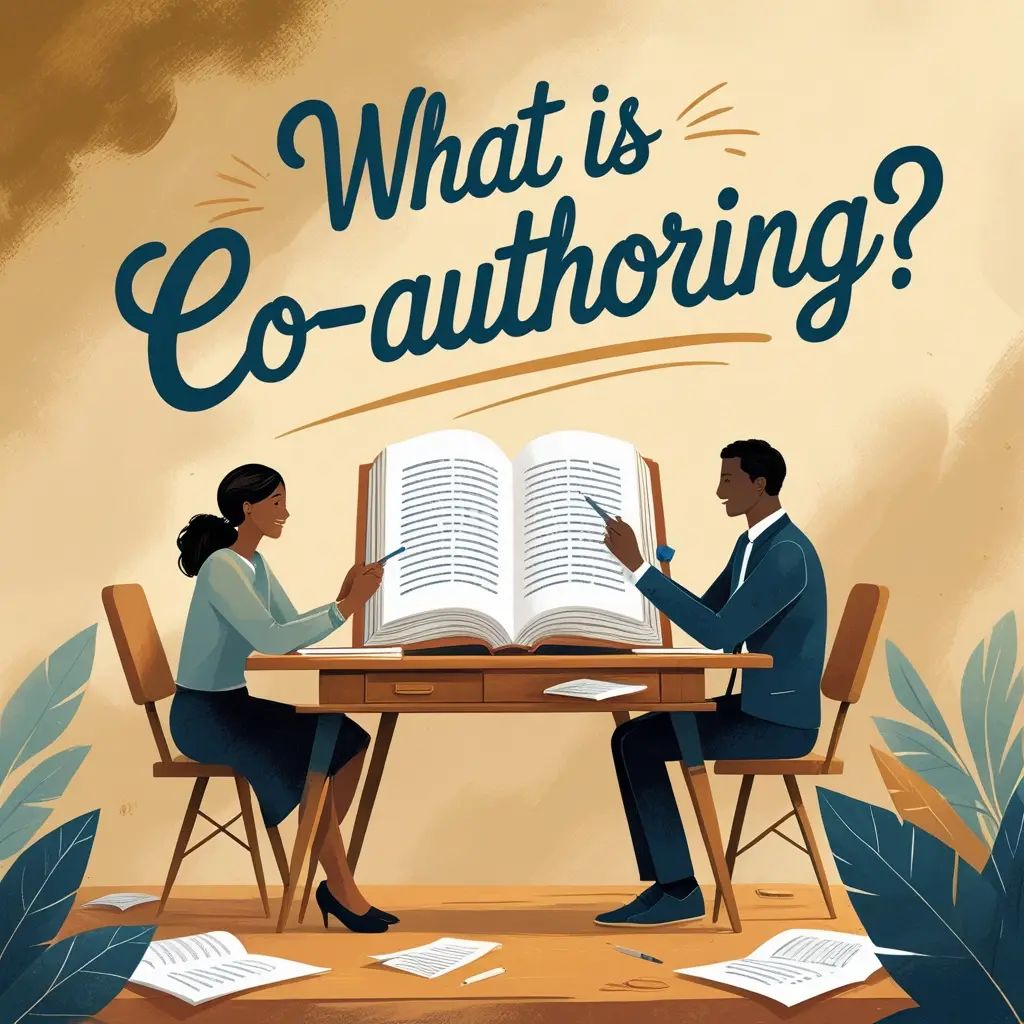
Co-authoring is completely different from ghostwriting because co-authoring is when multiple individuals are jointly contributing to a single piece of writing.
This is when everyone involved in the process of writing is credited as the author.
The simple way to understand this is that when a single person writes something, they alone can take the credit for it as the author but when they involve other people as contributors to the project in the same capacity as an author then those other people become co-authors.
This is different from ghostwriting because in the case of ghostwriting the ghostwriter knows beforehand that they are only providing a service and that their names will not be in the credits.
Meanwhile, co-authoring projects involve the mutual contribution of multiple people and this is usually done in academic writing situations.
Key Characteristics of Co-Authoring:
Shared Credit: When it comes to go authoring, everybody shares the credit and all the names of the co-authors are listed by their author name typically on the cover of the book or even the byline.
Mutual Contribution: Co-authoring is all about mutual contribution where each author contributes different aspects of the content such as ideas and writing as well as research and the labour is distributed.
Collaborative Decision-Making: One of the most important characteristics of co-authoring is going to be decision-making because unlike ghostwriting where the client is responsible for all the decisions, in co-authoring the decision-making is done by all the authors and everything is agreed mutually.
Common in Fiction & Non-Fiction: This pattern of understanding and working together in the form of co-authoring can be mostly seen in academic publications and non-fiction works but it can also be visible in fiction.
So, What Is the Difference?

The difference between ghostwriting and co-authoring is simple. Ghostwriting is a professional service provided by professional writers and the entire premise of the service is anonymity.
Co-authoring is the agreement of mutual contribution of multiple authors on a single project and shared ownership and rights. In the case of ghostwriting, the ownership is only held by the client.
If we now consider the point about compensation then ghostwriting is a service where the client pays the ghostwriter for the content they are writing. Compensation on the other hand for co-authoring is based on royalties and shared profits that have been agreed between the authors.
These two terms have their different needs because a ghostwriter is needed when a person is in need of high-quality content that they themselves cannot produce.
It should be primarily thought of as a service and anyone can hire a ghostwriter and ask them to write content for them.
Co-authoring is not a service but an arrangement where multiple people passionate about a single project come together and mutually agree to contribute to that single project.
They also agree to share the profits generated from that project and they also agree to have all their names credited on the cover of the book.
Creative Control: Who Makes the Final Decisions?
One of the biggest differences between ghostwriting and co-authoring is creative control. When you hire a ghostwriter, the project is built around your vision, your goals, and your authority. The ghostwriter may shape the language, structure, and readability of the manuscript, but the final direction stays with you. In most cases, the ghostwriter works to bring your message to life rather than add their own public creative identity to the book.
With co-authoring, the creative process is more collaborative. A co-author does not just help with execution. They often contribute their own ideas, help shape the book’s concept, and take part in major writing decisions. This makes co-authoring a better fit for projects where both people want to help build the book together from the inside out.
Work-for-Hire vs Shared Authorship
Another missing topic is the legal and business structure behind each arrangement. Competitor pages frequently explain that ghostwriting usually works as a work-for-hire relationship, where the client commissions a professional writer to create the manuscript and retains the authorship, ownership, and public credit. That structure is one of the main reasons ghostwriting appeals to founders, executives, experts, and public figures who want a book under their own name.
Co-authoring is different because it is based on shared authorship. Both contributors are part of the book’s identity, and both may have a claim to creative input, rights, and long-term decisions related to the project. That makes co-authoring more suitable when both people are genuinely building the intellectual and creative work together.
Royalties, Rights, and Payment Structure
Your current blog briefly mentions payment, but competitors explain this much more clearly. In ghostwriting, the writer is generally paid a flat fee or project fee for the writing service. The client typically keeps the copyright, intellectual property, royalties, and revenue from the finished book. This is one of the clearest reasons many authors choose ghostwriting over co-authoring.
In co-authoring, the rewards are often shared. That can include royalties, rights, profits, and sometimes long-term recognition associated with the book. Because the co-author is publicly attached to the work, compensation is usually tied not just to the labor of writing, but also to the shared value of authorship and collaboration.
Ghostwriting vs Co-Authoring for a Book Project
Many readers searching this topic are not asking for a dictionary definition. They want to know which option fits their book project. If you have a strong idea, a clear message, and want the book to be fully yours, ghostwriting is usually the better choice. It is especially useful when you have expertise, stories, or authority but do not have the time, writing experience, or publishing knowledge to turn that into a polished manuscript.
Co-authoring makes more sense when both people want to actively shape the material and both deserve visible authorship credit. This can work well when two experts are combining insights, or when a collaborative voice is part of the value of the book itself.
When Should You Choose a Ghostwriter?
A dedicated “when to choose” section is a major competitor gap in your article. You should choose a ghostwriter when you want full ownership, a single public author name, and a finished manuscript shaped around your message and positioning. This is often the best path for business books, memoirs, expert-led nonfiction, personal brand books, and founder stories.
Ghostwriting is also ideal when you need speed, structure, and professional execution without giving up control of the final product. It allows you to stay focused on your expertise while a professional writer handles interviews, drafting, organization, and refinement.
When Should You Choose a Co-Author?
You should choose a co-author when the book is genuinely a shared creation. This is the better route when both contributors bring meaningful ideas, writing input, and long-term interest in the success of the work. A co-author is not invisible; they are part of the public identity of the book.
Co-authoring can also be useful when a project benefits from combined expertise, such as collaborative nonfiction, research-heavy books, or joint thought-leadership projects. But it requires strong communication, aligned expectations, and agreement on credit, revenue, and decision-making from the beginning.
Can a Ghostwriter Help with Publishing?
Competitors also add a practical point your blog is missing: many readers want to know whether a ghostwriter only writes, or also helps beyond the draft. Some ghostwriting services support clients through parts of the publishing process, including manuscript development, editing coordination, and guidance on next steps after the draft is complete. That matters because buyers often look for more than words on a page. They want help moving from idea to book.
Adding this section gives you a strong commercial bridge from informational intent to service intent. It also helps you target search phrases related to publishing support, book development, and manuscript preparation.
Quick Comparison: Ghostwriting vs Co-Authoring
If readers are skimming, a compact summary section helps. Competitors often use “one-sentence version,” “key takeaways,” or “at a glance” sections for this exact reason. Ghostwriting gives you full credit, full ownership, and full control, while co-authoring gives you shared credit, shared ownership, and shared creative input. That single summary is one of the strongest ways to satisfy search intent fast.
CONCLUSION
We hope you now understand the primary difference between ghostwriting and co-authoring.
If you and your author friends are passionate about a single project and can contribute to it mutually then that would be called co-authoring.
However, if you are someone who simply does not have the experience or time but is in need of high-quality professionally written content then you would need a ghostwriter.
That is where we come in because we are Ghostwriting India and we are one of the most reputed and fastest-growing ghostwriter-for-hire agencies in India.
We will help you with all your content needs at the most competitive prices in the industry and we welcome you to visit our website and check out everything we do.


