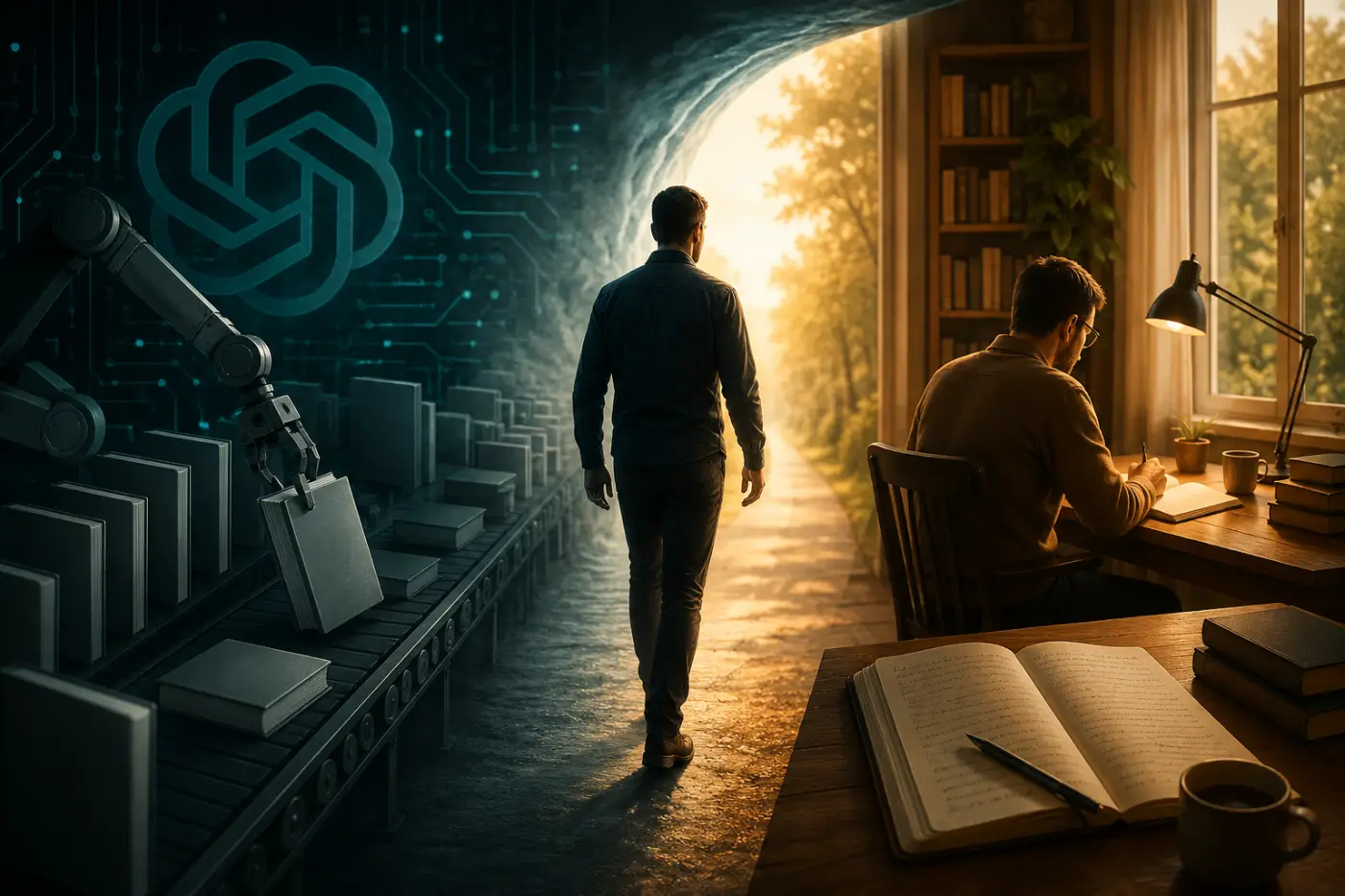
A year or two ago, the pitch sounded irresistible: feed a prompt into ChatGPT, wait a few minutes, and walk away with a finished manuscript. No advances, no deadlines, no awkward conversations with a writer who doesn’t quite “get” your vision. For a while, a lot of aspiring authors believed it.
Then the manuscripts came back from editors, beta readers, and publishers, and the verdict was surprisingly consistent. The chapters were grammatically clean but strangely hollow. The voice drifted. The story forgot what it promised on page ten. And quietly, many of those same writers started looking for a human again.
In this article, we’ll walk through exactly why ChatGPT can’t write a good book on its own, where the technology genuinely helps, and why hire a human ghostwriter has become the phrase we hear most often from authors who tried the shortcut first.
Why ChatGPT Can’t Write a Good Book From Start to Finish
Let’s be fair to the tool. ChatGPT is remarkable at producing fluent, readable sentences on demand. The problem isn’t sentences. It’s everything that holds a book together above the sentence level.
A book is a long argument or a long emotional arc. It needs a thesis it commits to for 60,000 words, characters who change in believable ways, and payoffs that land because they were set up forty pages earlier. ChatGPT generates text in chunks and has no durable sense of the whole. Ask it to write chapter twelve and it doesn’t truly remember the promise it made in chapter two. The result is prose that reads fine line by line but unravels when you step back and look at the shape of the thing.
This is the core reason why ChatGPT can’t write a good book unsupervised: it optimizes for the next plausible sentence, not for a coherent journey from cover to cover.
The “Average of Everything” Problem
AI models are trained to predict what’s statistically likely. That makes them excellent at producing the most expected version of any idea. But good books rarely succeed by being expected. They succeed through a specific point of view, an unusual turn of phrase, a risk a cautious writer wouldn’t take.
When you ask ChatGPT for a metaphor, you tend to get the metaphor everyone already uses. The output gravitates toward the middle of the bell curve, which is precisely where forgettable writing lives.
Where the Voice Disappears
Readers don’t fall in love with information. They fall in love with a voice. A memoir works because we feel we’re sitting across from a real person. A business book works because the author’s hard-won opinions come through with conviction.
ChatGPT has no lived experience to draw from. It can imitate a tone you describe, but it can’t sustain a genuine personality across hundreds of pages, and it can’t tell you the one story from your life that would make a chapter unforgettable. We’ve reviewed AI-drafted manuscripts where the “voice” shifted three times in a single chapter, sounding like a teenager, then a consultant, then a Victorian novelist.
That instability is one of the clearest signals editors use to spot machine-written work, and it’s a recurring theme in our look at whether AI-generated content is good enough for books.
Facts, Fabrication, and the Trust Problem
A book carries your name. Whatever sits between the covers becomes your reputation.
This is where AI gets genuinely risky. Large language models confidently invent facts, misattribute quotes, and cite sources that don’t exist. In a nonfiction title, a single fabricated statistic or a misquoted expert can sink your credibility and, in some fields, expose you to legal trouble. A human ghostwriter researches, verifies, and flags what they’re unsure about. ChatGPT will happily hand you a polished paragraph built on something it made up.
For any author serious about authorship, this matters deeply. We explore the responsibility that comes with putting your name on a book in our piece on the ethics of authorship.
Structure, Pacing, and Knowing What to Leave Out
Writing a book is as much about deletion as creation. A skilled ghostwriter knows when a scene is dragging, which subplot to cut, and how to pace a reveal so it lands. They sense when a reader will get bored three pages before the reader does.
ChatGPT has no instinct for restraint. Ask it to expand a chapter and it expands. Ask for more detail and it pads. It can’t feel the rhythm of a page or recognize that a quiet moment would hit harder than another burst of action. The architecture of a satisfying book, what to reveal, what to withhold, what to repeat for emphasis, is a deeply human craft.
Why Hire a Human Ghostwriter Instead
By now the contrast is probably clear, but it’s worth stating plainly why hire a human ghostwriter remains the better investment for a book that needs to last.
A professional ghostwriter brings four things ChatGPT structurally cannot:
- Continuity of vision.They hold your entire book in their head and shape every chapter toward one outcome.
- A real point of view.They push back, suggest a braver angle, and protect what makes your story yours.
- They stake their professional reputation on accuracy and quality, and they’re reachable when something needs to change.
- They interview you, mine your experiences, and turn the stories only you can tell into prose.
The goal isn’t to romanticize humans or demonize software. It’s to match the tool to the job. If you’re not sure how to tell a genuine professional from someone reselling AI output, our guide on how to identify a professional ghostwriter lays out the warning signs.
The Smart Middle Path: Humans Using AI Well
Here’s the nuance most “AI vs. humans” debates miss. The best ghostwriters today don’t ignore ChatGPT. They use it as an assistant, never as the author.
A professional might use AI to brainstorm chapter angles, untangle a clumsy sentence, or summarize research, then bring all of it under human judgment, voice, and fact-checking. The machine drafts raw clay; the human sculpts the book. That’s a completely different process from typing a prompt and publishing whatever appears. If you’re curious how this collaboration actually works in practice, we break it down in our ghostwriter briefing guide for using ChatGPT and Claude.
Frequently Asked Questions
Can ChatGPT write an entire book by itself? It can generate text that looks like a book, but it can’t sustain a coherent voice, plot, or argument across the full length, and it may invent facts. That’s the short answer to why ChatGPT can’t write a good book without significant human direction.
Is AI-written content automatically rejected by publishers? Not automatically, but editors are increasingly skilled at spotting AI’s tells, inconsistent voice, generic phrasing, and shallow structure. Manuscripts that lean entirely on AI tend to get flagged or returned for heavy revision.
Why hire a human ghostwriter when AI is cheaper? Because a book carries your name and reputation. A human delivers continuity, verified facts, a genuine voice, and accountability, which is exactly what cheap AI output lacks. We unpack the cost question in our article on the difference between affordable and premium ghostwriting.
Can a ghostwriter and AI work together? Yes, and the best ones do. They use AI for brainstorming and drafting support while keeping authorship, voice, and fact-checking firmly in human hands.
Conclusion: Your Book Deserves a Human Author
The wave of authors returning to human writers isn’t nostalgia. It’s a practical response to a simple truth: ChatGPT can assist a book, but it can’t author one. The gaps in voice, structure, accuracy, and vision are not bugs that the next update will fix. They’re the difference between generating text and telling a story that’s truly yours.
If you’ve felt the limits of AI firsthand, or you simply want your book done right the first time, this is the moment to bring a professional into the process. Talk to our team at Ghostwriting India about turning your idea into a book readers actually finish, and remember. We’ll help you combine the best of human craft with smart tools, so your name sits proudly on something worth reading.


